New: Pressure test your SOC 2 report against buyer requirements
Free check
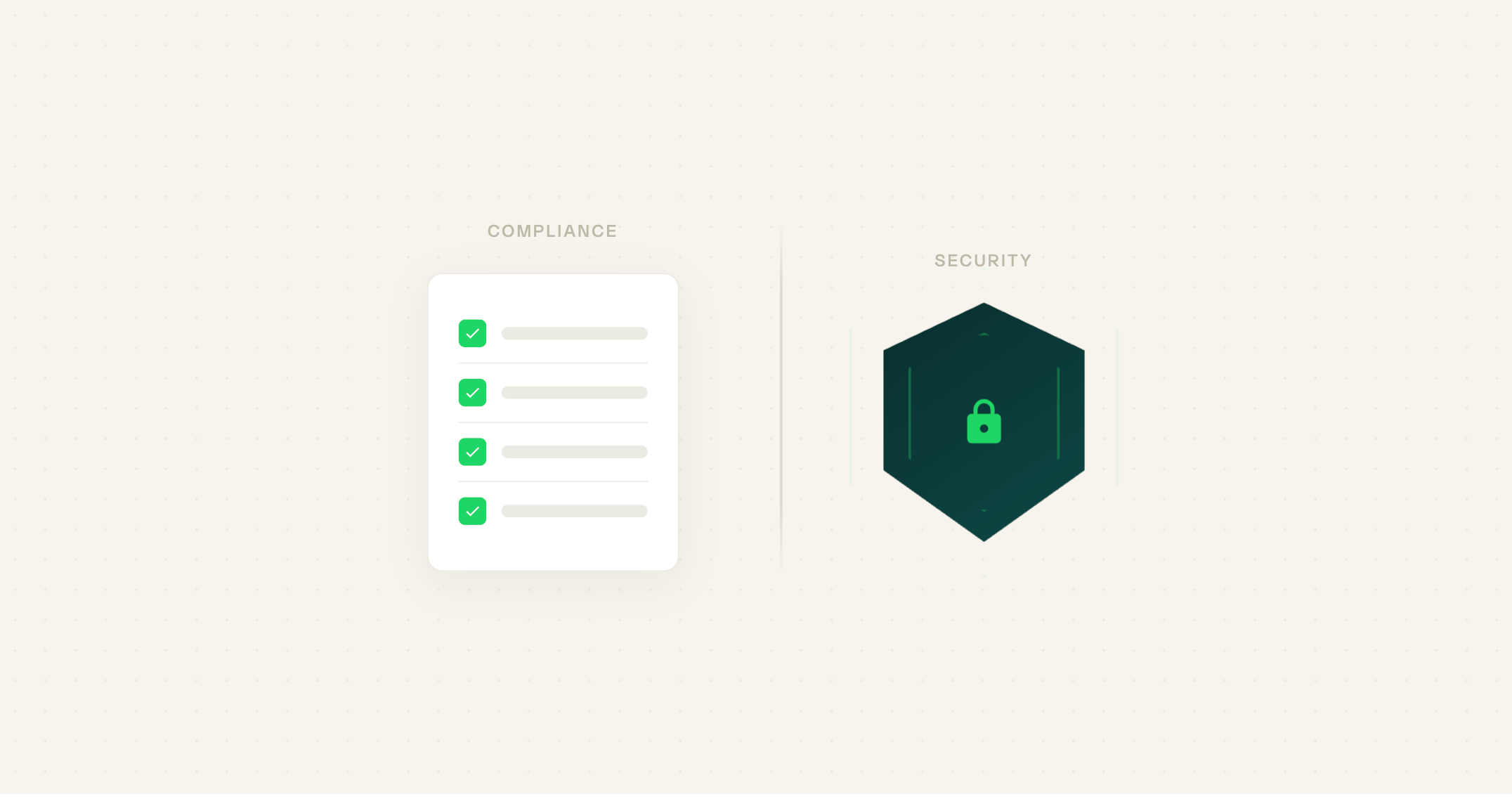
Your SOC 2 badge proves you documented controls. It doesn't prove you're secure. Learn why compliance alone fails and what real security looks like alongside it.
You passed your SOC 2 audit. The badge is on your website. Your sales team is using it in every enterprise conversation. And then three months later, a security researcher emails you about an S3 bucket that's been publicly readable since before the audit started.
The bucket wasn't in scope. The auditor never looked at it. The badge didn't lie, exactly. It just didn't mean what you thought it meant.
This is the gap between compliance and security. Compliance proves you documented controls and an auditor verified them. Security is whether those controls actually protect you. The difference matters more than most founders realize.
A SOC 2 Type II report proves that your controls existed and operated over a defined period. It does not prove those controls prevented anything.
Auditors evaluate documented policies, evidence of control execution, and consistency over the observation window. They check that you did the thing, not that the thing worked. Your quarterly access review ran on schedule? Great. Whether you actually revoked the access it flagged is a separate question, and not one most auditors are asking.
There's also a scope problem. Auditors evaluate what's in the audit scope. If your staging environment or that legacy service nobody wants to touch aren't explicitly included, it doesn't matter how misconfigured they are. The moment a report is issued, it's already drifting from reality. Your infrastructure changes weekly. The report doesn't.
SOC 2 is built on the AICPA's Trust Services Criteria, a framework designed to give third parties (your prospects, your partners, your customers) a standardized way to evaluate your security posture. That's useful. But it's a communication tool, not a defense system.
Some of the most compliant companies are also the most vulnerable, because compliance incentivizes documentation, not detection.
Consider what passes an audit without making you meaningfully more secure:
Access reviews that produce a nice screenshot for the evidence folder but never result in revoked access. Vulnerability scanning that runs on schedule and produces reports nobody triages, with a critical CVE buried on page 12 of 347 findings. Incident response plans that exist as Google Docs with a "Last edited 14 months ago" timestamp.
The pattern is the same every time. The control ran. The evidence exists. The underlying problem wasn't fixed.
Compliance creates incentives to prove you did something. Security creates incentives to prove something works.
Tools like Vanta, Drata, and Secureframe automate compliance evidence collection. They pull screenshots, collect policy acknowledgments, track access reviews, and map controls to framework requirements.
They don't run CSPM scans on your AWS account. They don't analyze your dependency tree for vulnerabilities. They don't monitor your endpoints or detect anomalous API calls. GRC tools automate the evidence layer. The technical security layer is a different stack entirely.
A GRC dashboard showing "all controls passing" means evidence was collected on schedule. It doesn't mean your infrastructure is hardened or your dependencies are clean. You can pass every audit and still get breached, because certifications and security operate on different planes.
According to IBM's 2024 Cost of a Data Breach Report, it takes organizations an average of 194 days to identify a breach and another 64 days to contain it. That's over eight months of exposure. If your security posture is just "we passed our audit," you're trusting a point-in-time attestation to protect you for a year.
GRC tools solve the compliance problem. They don't solve the security problem. You need both layers.
Real security is the set of practices that reduce your actual risk, independent of whether an auditor is watching.
You make decisions, not just lists. When a vulnerability surfaces, someone owns it. There's a decision: fix now, schedule for next sprint, or accept the risk with eyes open. You won't reach inbox zero on vulnerabilities. That's fine. What matters is that findings don't sit in a dashboard for six months because nobody triaged them.
You know what matters. Not every CVE is a crisis. You can distinguish between a critical vulnerability in a production dependency and a medium-severity finding in a dev tool that never touches customer data. Your prioritization is based on real exposure, not just severity scores.
You catch problems before they ship. Security checks run in your CI pipeline, not as a quarterly exercise. A misconfiguration gets flagged in the PR, not three months later when someone audits your AWS account.
You notice when things drift. Your infrastructure changes constantly. Real security means knowing when someone opened a port, added a public bucket, or granted admin access. Not during the next audit prep cycle, but when it happens.
Evidence is a byproduct, not a project. When your security controls are automated and running continuously, the audit trail generates itself. The access review logs itself. The scan produces an SBOM. You don't prepare for audits because the evidence already exists.
Startups that treat compliance as the goal end up rebuilding their security posture every audit cycle. Startups that treat security as the goal pass audits as a side effect.