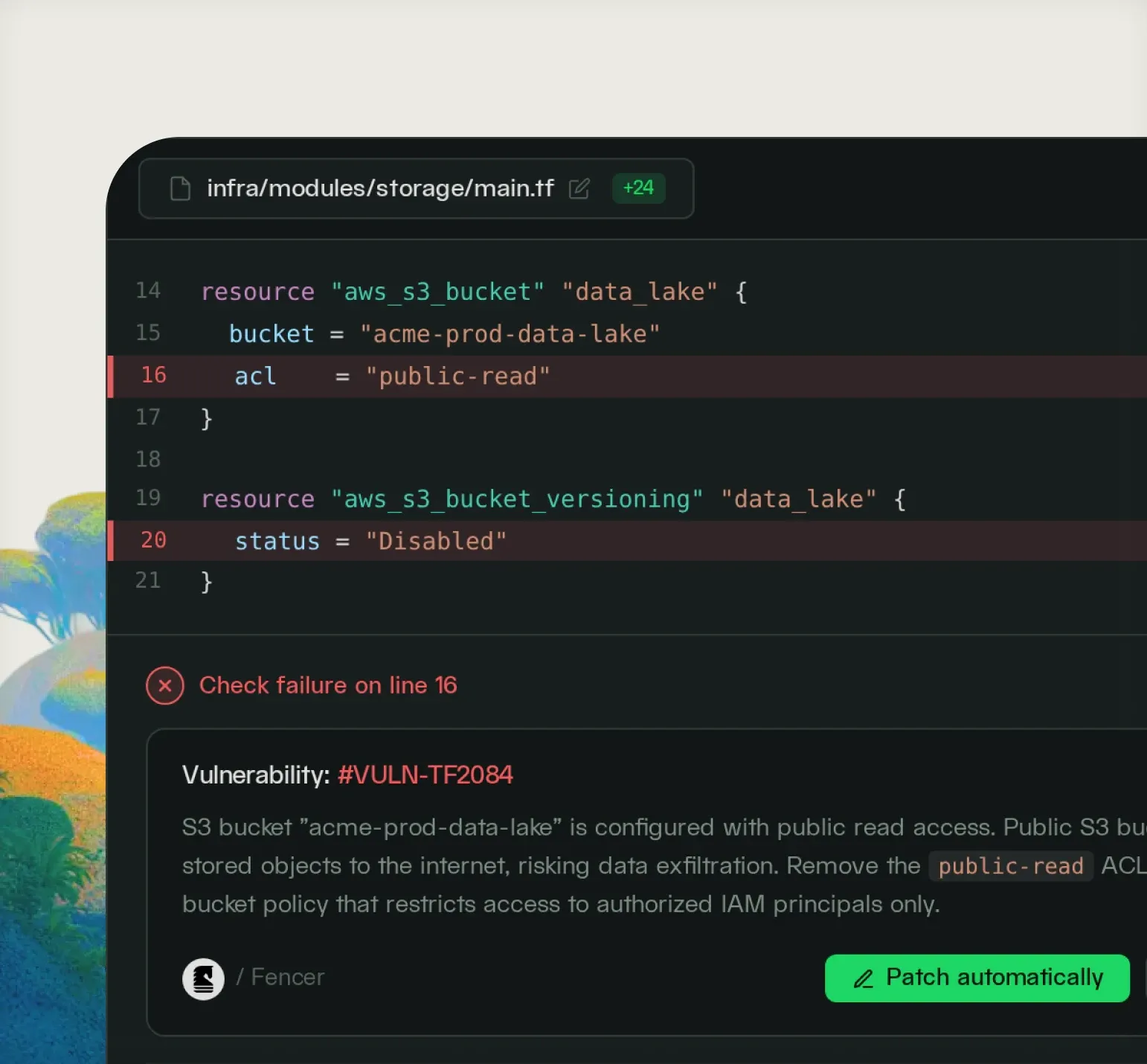
IaC scanning that catches misconfigurations in the PR
Fencer scans Terraform, CloudFormation, Kubernetes, Helm, and Azure ARM on every PR. Misconfigurations surface as inline annotations before anything reaches your cloud accounts.
Why Fencer?
IaC scanning built into your CI/CD
Connect your repos and get your first IaC scan results in minutes. No complex configuration required.
Fencer scans your IaC templates on every PR and runs background scans on a regular schedule.
All of your startup security essentials covered by one startup-friendly suite.
Capabilities
Catch cloud misconfigurations before they're exploitable
IaC misconfiguration scanning on every PR
Fencer scans IaC templates as part of its standard code scanning workflow, triggered on every pull request and on a daily schedule.
- Supported frameworks: Terraform, CloudFormation, Kubernetes manifests, Helm charts, and Azure ARM/Bicep templates
- PR triggers: Scans run automatically on PR open, PR update, and PR merge via your existing GitHub, GitLab, or Bitbucket integration
- Daily scheduled scans: Repositories are also scanned daily to catch misconfigurations introduced outside of pull requests
- No separate setup: IaC scanning is part of code scanning. No additional integration steps required
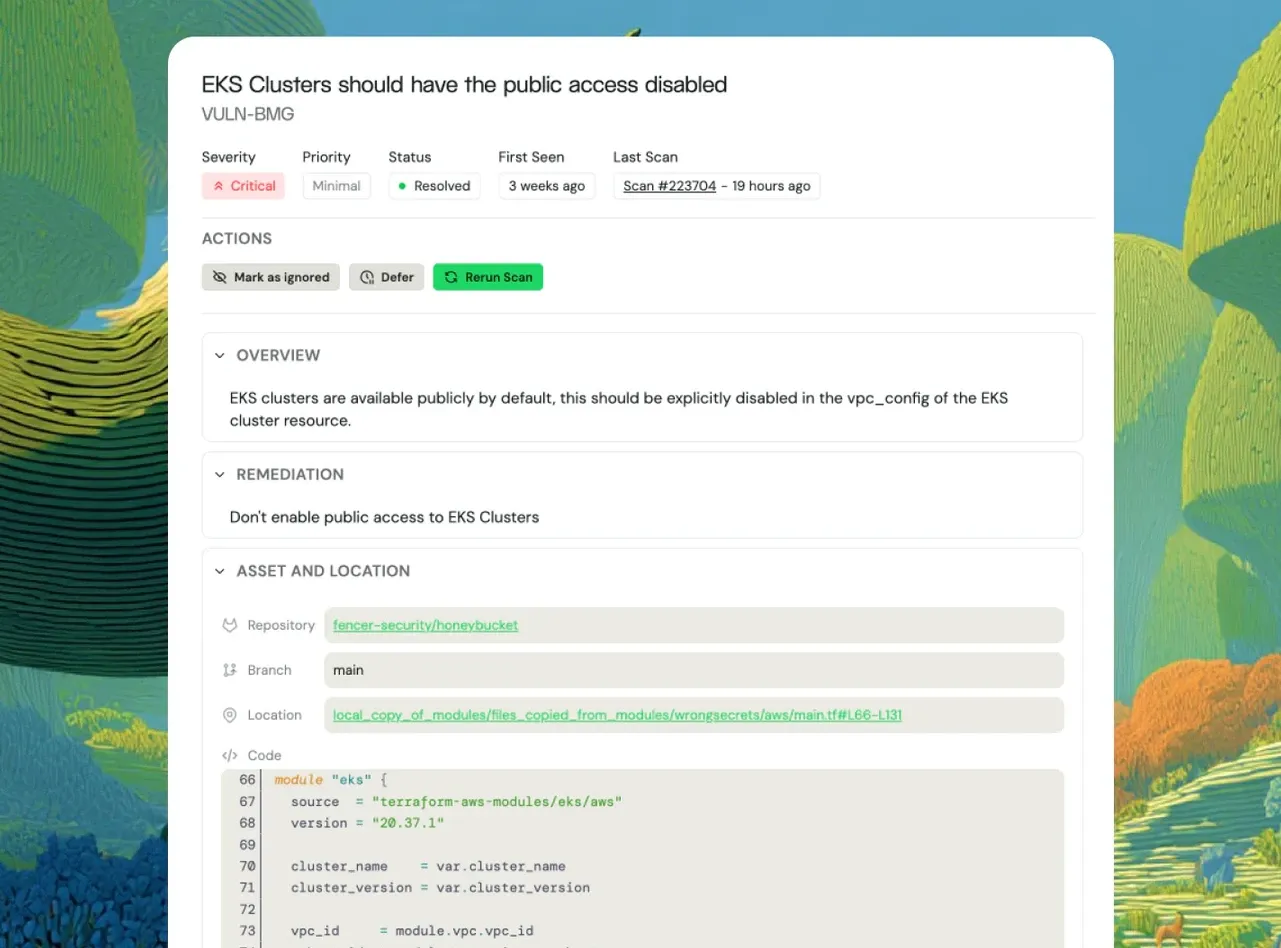
Automated IaC remediation, straight to your repo
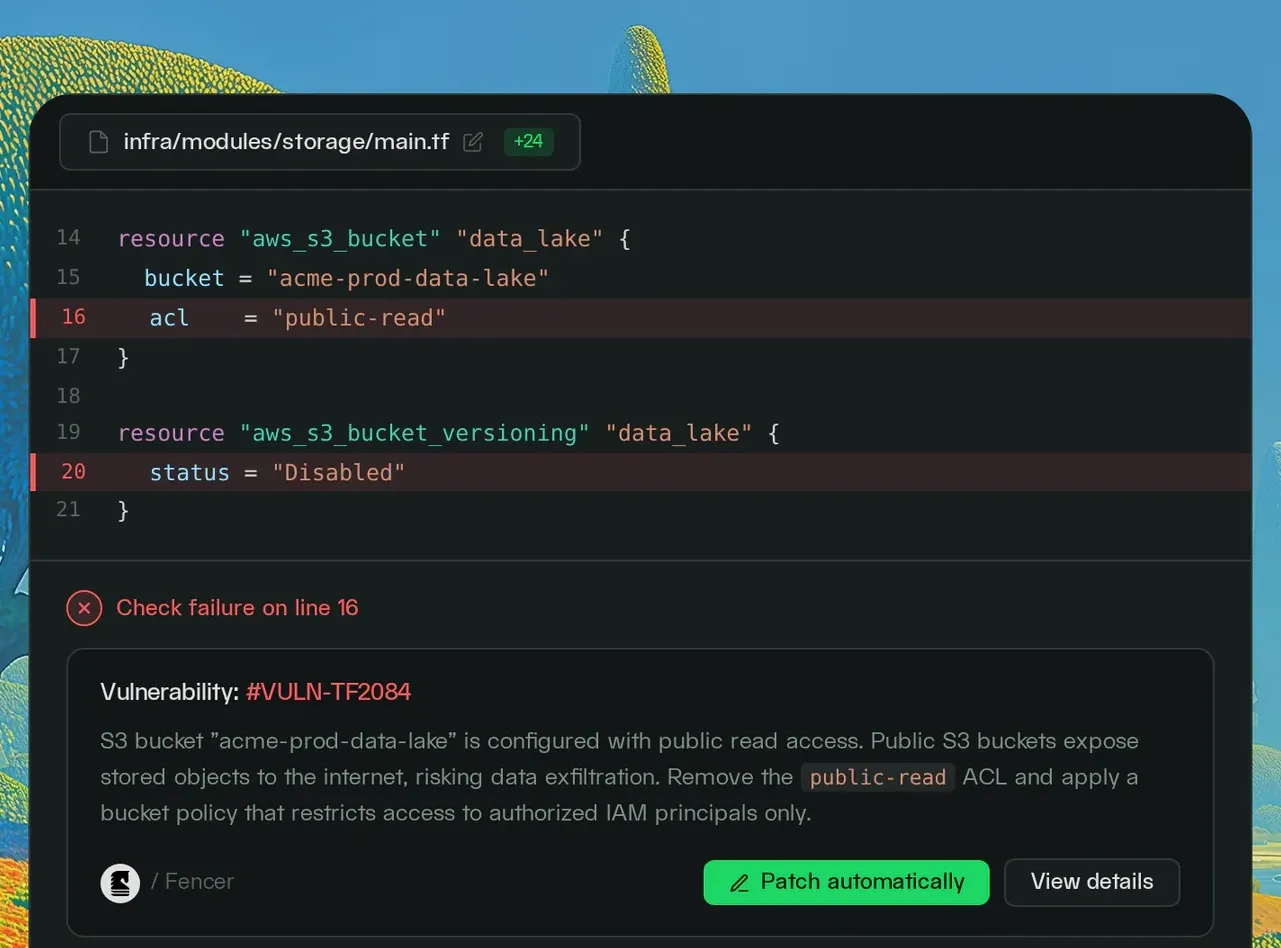
When Fencer detects a misconfiguration in an IaC template, it surfaces an inline annotation on the exact line that introduced it. You can then trigger an AI fix agent to generate a patch and open a pull request so the issue is resolved without leaving your workflow.
- Inline annotations: Findings appear directly on the changed lines in the PR diff, not in a separate dashboard
- File and line reference: Each annotation shows the exact file and line where the misconfiguration was introduced
- AI fix agent: Generates a patch for the misconfiguration and opens a pull request in your repo, with a full explanation of what changed and why
- Configurable failure conditions: PRs can be set to fail when IaC misconfigurations above a severity threshold are detected
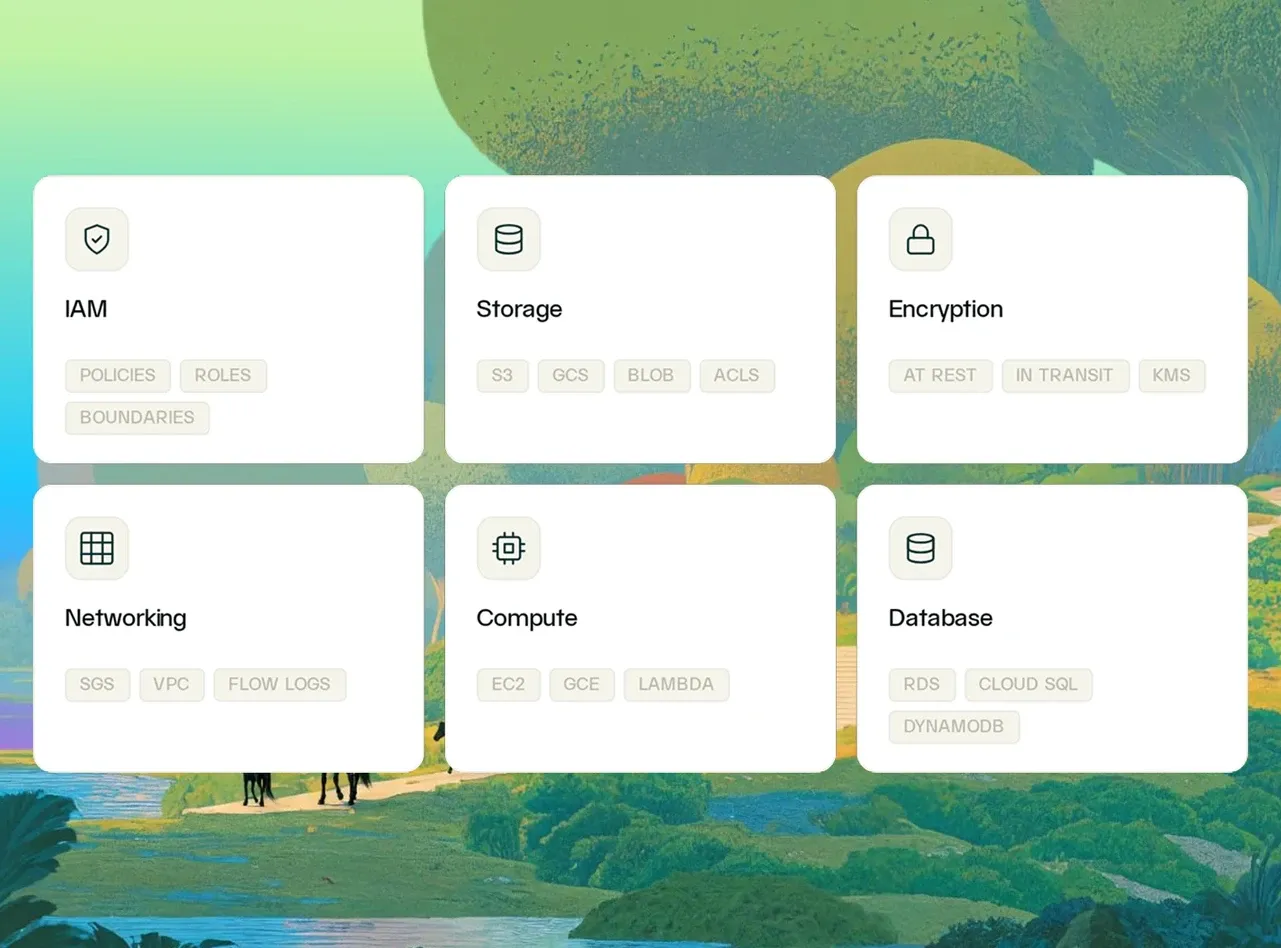
Misconfiguration checks across six categories
Fencer's IaC scanning checks for misconfigurations across the same categories it monitors in live cloud accounts: IAM, storage, encryption, networking, compute, and database. The same issues that CSPM finds in production can be caught in your templates before they're ever deployed.
- IAM: Overly permissive policies, wildcard access, and missing privilege boundaries in roles and service accounts
- Storage: Public access settings and insecure ACL configurations on S3 buckets, GCS, and Azure Blob Storage
- Encryption: Missing encryption at rest on databases, volumes, and storage resources
- Networking: Security groups open to 0.0.0.0/0, unrestricted inbound access, and missing VPC flow log configuration
- Compute and database: Insecure instance configurations and publicly accessible database settings
What can you do with Fencer's IaC security capabilities?
Stop misconfigurations before they reach AWS
A Terraform file with a public S3 bucket or permissive IAM role will deploy exactly as written. Fencer flags it in the PR so it never makes it to your cloud account.
Give auditors evidence of pre-deployment checks
SOC 2 auditors increasingly ask about pre-deployment infrastructure controls, not just runtime monitoring. Fencer's scan history shows every IaC check that ran, when it ran, and what it found.
Keep security standards consistent across new infrastructure
Every new Terraform module and CloudFormation template gets scanned automatically. Make security the standard as your cloud footprint grows.
Close the gap between IaC scanning and CSPM
CSPM monitors your live infrastructure. IaC scanning covers what gets deployed into it. Together, they close the loop on cloud misconfiguration from code to production.

“Almost immediately after working with Fencer, we found a couple critical vulnerabilities in our infrastructure that we were lucky to never have had a real outcome from. We immediately fixed those.”
- David Merritt, CTO, Watch Duty
Take Fencer for a spin
Start a free trial in minutes, or book a demo for a guided tour.