New: Pressure test your SOC 2 report against buyer requirements
Free check
The five most common security risks for B2B SaaS companies, from stolen credentials to weak tenant isolation, and what to do about each one.
When you're selling software to other businesses, your security gaps don't just affect you. They affect your customers. A breach at your company becomes a breach at theirs. Their data, their reputation, their trust in you.
Your customers put your code in their stack, your integration in their workflow, their data in your database. If you get compromised, you take them down with you. That's the kind of incident that ends vendor relationships, triggers notification requirements, and shows up in their board meetings.
This article covers the five security risks most likely to cause that outcome, and what to do about each one.
Most breaches don't start with a sophisticated exploit. They start with a login.
Credentials are the number one initial access vector in breaches, year after year. Verizon's 2025 Data Breach Investigations Report found that stolen credentials were involved in 22% of breaches overall, and 88% of attacks against basic web applications. Attackers don't need to find a vulnerability in your code if they can just log in as someone who works there.
For B2B SaaS companies, this risk has two faces.
Passwords and user accounts. Phishing remains effective. Credential stuffing works because people reuse passwords. And once an attacker has valid credentials, they look like a legitimate user until they don't.
Secrets in your codebase. API keys, database connection strings, service account tokens, private keys. These are credentials too, just not the kind your employees type in. A secret committed to a repository lives in git history forever, even after you delete the file. A leaked AWS key can rack up a six-figure bill in hours, or worse, give an attacker a foothold in your infrastructure.
For user credentials:
For secrets:
Your application ships hundreds of third-party packages you've never read. Each one is a potential entry point.
When a new CVE drops in a popular library, you're in a race. Attackers are scanning for vulnerable systems within hours of disclosure. For critical vulnerabilities in edge devices and internet-facing systems, the 2025 DBIR found the median time between publication and mass exploitation was effectively zero days.
For B2B SaaS companies, the stakes are higher than just your own systems. If you're running a vulnerable version of a library that handles customer data, and that vulnerability gets exploited, you're now explaining to your customers why their data was exposed through your negligence.
The principle of least privilege sounds obvious until you look at how most startups actually operate.
Engineers get admin access to everything because it's easier than figuring out what they actually need. Contractors get the same permissions as full-time employees. Service accounts get created with broad access for a one-time migration and never get scoped down.
Then someone leaves. Maybe they're still in Slack for a few days while IT catches up. Maybe their access to that one SaaS tool never got revoked because nobody remembered it existed. In 2021, a former Cash App employee accessed and downloaded data for 8.2 million customers after termination. The breach took four months to discover.
For B2B SaaS companies, this is particularly dangerous because your employees often have access to customer data as part of their jobs. An overly permissive account that gets compromised, or an ex-employee who retains access, can reach data belonging to every customer you serve.
You're not just responsible for your own security. You're responsible for the security of every vendor you integrate with.
In summer 2025, a compromise at Salesloft cascaded into more than 700 organizations. The attack didn't exploit a zero-day. It started with a GitHub account compromise, moved to cloud persistence, and then used stolen OAuth tokens to access Salesforce instances belonging to Salesloft's customers. The victims included major cybersecurity vendors: Palo Alto Networks, Cloudflare, Zscaler, Tenable.
For B2B SaaS companies, this cuts both ways. You're exposed to the security posture of your vendors. And your customers are exposed to yours. When you integrate with a customer's Salesforce, Slack, or data warehouse, you become part of their supply chain. If your integration gets compromised, their data gets compromised.
The 2025 DBIR found that breaches involving third parties doubled year over year, now accounting for 30% of all breaches.
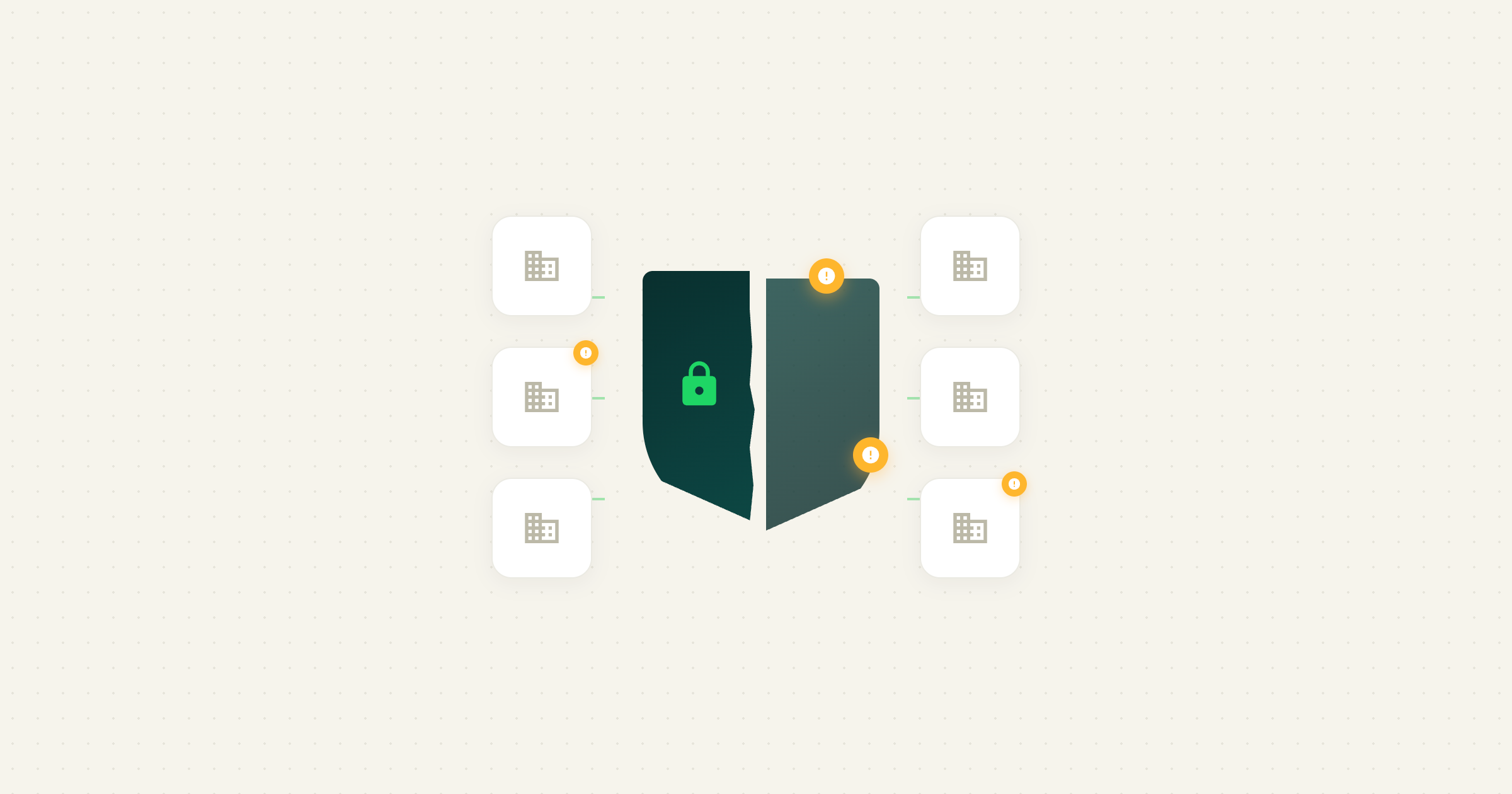
Most B2B SaaS products run on multi-tenant architecture. Multiple customers share the same application, the same database cluster, the same infrastructure. It's cost-effective and operationally simpler. It's also a single point of failure.
Tenant isolation is what keeps Customer A's data from showing up in Customer B's dashboard. When it breaks, it's not a bug. It's a breach. And it's the kind of breach that's uniquely damaging to B2B SaaS companies because it means you exposed one customer's data to another.
These failures rarely come from a single obvious flaw. They emerge from small architectural shortcuts: a missing tenant filter in a database query, a background job that runs outside tenant context, a cache key that doesn't include the tenant identifier, a search index that returns results across tenants.
For B2B SaaS companies, security isn't a feature you add when you have time. It's the foundation that makes everything else possible.
Your customers are trusting you with their data. Their security posture depends partly on yours. The enterprise deals you're trying to close, the SOC 2 report you just passed, the security questionnaire you're filling out right now: all of that assumes you've got the basics handled.
The five security risks in this article are not rare. They're the ordinary ways B2B SaaS companies get breached: stolen credentials, unpatched dependencies, excessive access, vulnerable vendors, and broken tenant isolation. None of them require a sophisticated attacker. All of them are preventable with the right practices and tooling.
Fencer helps B2B SaaS companies cover these risks from a single platform: secret scanning, dependency analysis, access reviews, infrastructure monitoring, and continuous vulnerability management. No security team required.