Pen testing tools have never been more varied or more confusing to evaluate. The category now spans autonomous AI agents, crowdsourced human experts, and hybrid platforms, and most of them make the same promise: proof-based security testing. Before you compare features, know which of three different groups you are looking at, because they solve different problems for different buyers.
This comparison covers nine tools across six dimensions: proof of exploit, attack-path chaining, remediation (whether it fixes or just flags), retest policy, compliance output, and pricing transparency.
Annual penetration testing doesn't work for software companies anymore
The traditional penetration testing process looked something like this: hire a firm, scope an engagement, wait three to six weeks for a PDF, then manually triage the findings, assign tickets, track remediation in a spreadsheet, and schedule a retest months later to confirm the fixes. Repeat next year. That model made sense when software shipped quarterly and attack windows were measured in months.
Software teams now ship daily or weekly, and attackers can find exploits in recently shipped code before a scheduled test would catch them. In response, new tools have emerged that prove exploits automatically, integrate with developer workflows, and run on demand rather than on a calendar. They have also produced a market full of vendors making identical promises with meaningfully different products underneath.
The 9 tools at a glance
| Tool | Category | Proof of exploit | Attack-path chaining | Fixes applied | Free retest | Speed to results | Compliance output | Published pricing |
|---|---|---|---|---|---|---|---|---|
| Fencer | Find-and-fix | Yes, exploit-gated | Yes, step by step | Yes (code PRs, cloud API) | Yes (unlimited) | ~35 min (small scope) to several hours | Yes | Yes ($3,000 AI-led) |
| Aikido | Find-and-fix | Yes (PoC + repro) | Yes | Yes (AutoFix) | Yes (4-month window) | Hours | Yes | Yes (€3,500+ typical) |
| XBOW | Find-and-prove | Yes (reproducible traces) | Yes (decision log) | No | Yes | ~5 business days | Yes | No |
| RunSybil | Find-and-prove | Yes (live exploitation) | Yes | No | Unconfirmed | Real-time / per-PR | Unconfirmed | No |
| NodeZero | Find-and-prove | Yes (attack paths) | Yes | No | Yes (internal only) | Hours to days | Yes | No |
| Pentera | Find-and-prove | Yes (kill chains) | Yes | No | Yes | Days to weeks | Yes | No |
| Cobalt | Human-led | Partial (human-authorized) | Partial | No | Yes | Days to weeks | Yes | Partial (credit-based) |
| BreachLock | Human-led | Yes (human-validated) | Yes | No | Yes | Days to weeks | Yes | No |
| Terra Security | Human-led | Yes | Yes | No | Unconfirmed | Varies | Yes | No |
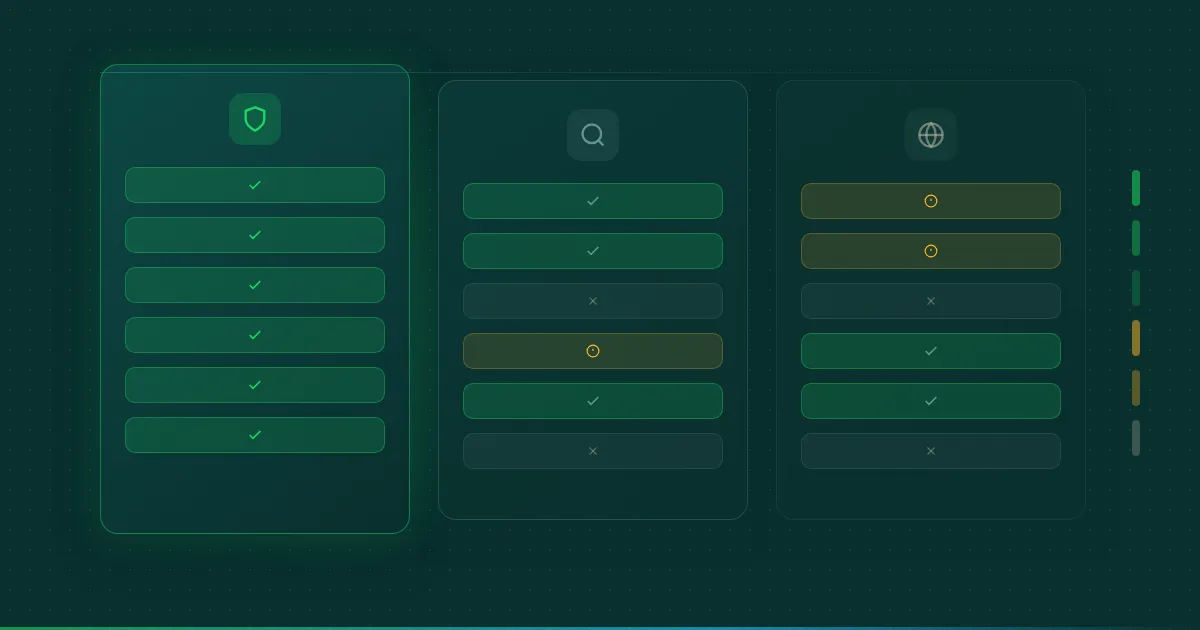
The market splits into three categories. Autonomous find-and-fix tools prove the exploit and apply the fix. Autonomous find-and-prove tools prove it and stop there. Human-led tools add expert review before findings are delivered. Each category answers a different question.
Autonomous pen testing with auto-remediation
Fencer and Aikido both prove exploits and close the loop into remediation. Both are consolidated security platforms where pen testing sits alongside SAST, dependency scanning, cloud security posture, and more.
Fencer
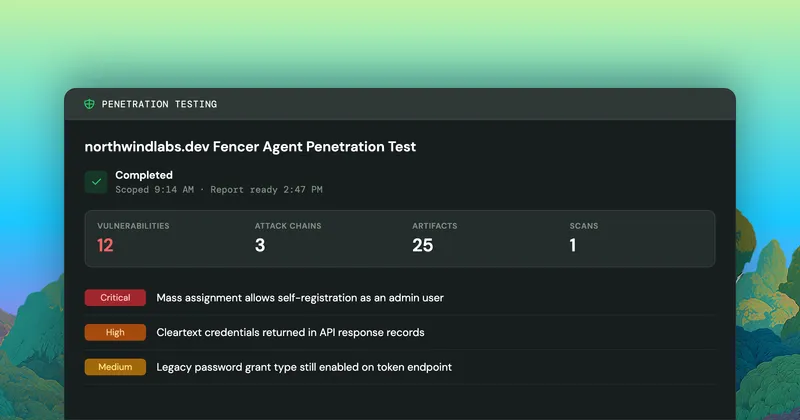
Fencer is a security platform covering pen testing, SAST, dependency scanning, cloud posture, and runtime protection, with pen testing also available as a standalone product. Its pen test engine is exploit-gated: a finding only reaches high or critical severity if the agent completed the exploit and retrieved evidence of impact.
- Proof of exploit: Exploit-gated severity with a Proof of Impact field per confirmed finding, showing exactly what the agent accessed or exfiltrated. Other findings are labeled Reachable rather than suppressed.
- Attack-path chaining: Findings are linked into full kill chains showing entry point, steps, and business impact.
- Remediation: Findings route into Fencer's fix engine, which opens code pull requests and applies cloud configuration corrections via API, then re-scans to confirm the fix closed the path.
- Speed to results: Configurable. As short as ~35 minutes for a smaller-scoped host or lower-intensity setting; several hours for broader coverage or higher intensity. Time scales with scope and depth, not days of scheduling.
- Retest: Unlimited free retests. Re-scan runs automatically when a finding is resolved.
- Compliance output: PDF report, GRC evidence sync, and audit artifacts. Testing follows OWASP Top 10 and the OWASP Web Security Testing Guide.
- Pricing: Published. AI-led autonomous test: $3,000 one-time. Human-led: $6,000. Continuous pen testing included on platform plans.
Aikido
Aikido /Attack uses autonomous agents with source code access by default, which gives it visibility into application logic before testing begins. The platform sits alongside Aikido's SAST, SCA, cloud, and runtime modules.
- Proof of exploit: Findings include proof-of-concept and reproduction steps.
- Attack-path chaining: Agents chain vulnerabilities across application, API, and cloud surfaces using agentic reasoning rather than a fixed rule library.
- Remediation: AutoFix opens merge-ready pull requests for pen test findings. Aikido maintains read-only access to your codebase; all changes are proposed as PRs you review before merging.
- Speed to results: Hours. A published Tyro Payments case study shows ~5.5 hours to complete testing (vendor-sourced).
- Retest: Included within a four-month window from the engagement date; automated on the Rightsized plan.
- Compliance output: Audit-grade reports with SOC 2 and ISO 27001 mapping. The Typical Pentest includes a human-reviewed compliance report tier.
- Pricing: Published. Typical Pentest: €3,500 to €4,000 per assessment. Rightsized: auto-priced on application complexity. Continuous: custom.
Autonomous find-and-prove
XBOW, RunSybil, NodeZero, and Pentera all prove exploits autonomously. Where they diverge is depth of coverage, who they are built for, and what happens after proof is delivered: in each case, remediation is guidance and the fix is yours to apply.
XBOW
XBOW's proof-of-exploit standard is the highest in this group: every finding ships with a reproducible attack trace, a working exploit, and a full decision log. Its public benchmark credibility (ranked on the HackerOne leaderboard, first autonomous system on Microsoft's MSRC leaderboard) is the clearest third-party signal in the category.
- Proof of exploit: Yes, full reproducible trace per finding.
- Attack-path chaining: Yes, full decision log showing the chain.
- Remediation: Developer-ready guidance. No code fixes or PR generation.
- Speed to results: ~5 business days for the Pentest On-Demand product.
- Retest: Integrated retest included.
- Compliance output: Claims support for 40+ frameworks (vendor-stated; independently unverified).
- Pricing: Not published. Moved from per-test pricing at launch to quote-based in 2026.
Scope is the constraint: XBOW covers web apps and APIs only. No network, infrastructure, cloud posture, or dependencies.
RunSybil
RunSybil targets development teams shipping on a fast cadence: it integrates into the CI/CD pipeline and can run on every pull request. It has raised significant capital and earned brand recognition with developer-first companies.
- Proof of exploit: Yes, live exploitation confirmed.
- Attack-path chaining: Yes.
- Remediation: Delivers findings with remediation suggestions. No code fixes applied.
- Speed to results: Real-time. Runs continuously and on every pull request.
- Retest: Unconfirmed from independent sources.
- Compliance output: Unconfirmed from independent sources.
- Pricing: Not published. Demo-only.
NodeZero
NodeZero (Horizon3.ai) has the strongest independent review corpus in the autonomous group, with scores on G2 and PeerSpot and a Gartner Customers' Choice recognition for automated security validation. It goes deep on internal networks, Active Directory, and cloud infrastructure.
- Proof of exploit: Yes, diagrammed attack paths chained to domain compromise.
- Attack-path chaining: Yes, its signature strength. The "Hack, Fix, Verify" framing holds up: attack paths are diagrammed, chained, and impact-scored.
- Remediation: Remediation guidance plus 1-Click Verify re-test for internal findings. NodeZero does not connect to your repository or apply code changes.
- Speed to results: Hours to days for external findings. Internal testing requires a self-hosted Runner VM to be deployed first.
- Retest: Yes, 1-click verify for internal findings. External re-test on roadmap at time of research.
- Compliance output: Yes.
- Pricing: Not published. Enterprise-scale; estimated range in the market runs to tens of thousands annually.
Deployment for internal testing requires a self-hosted Runner VM, a recurring friction point in reviews.
Pentera
Pentera has the most validated review corpus in this comparison, with approximately 300 reviews on Gartner Peer Insights. It fits large enterprises that need to validate existing security controls, particularly around Active Directory, ransomware scenarios, and credential exposure.
- Proof of exploit: Yes, full kill chains.
- Attack-path chaining: Yes, its core output.
- Remediation: Orchestrates tickets and guides remediation. No code fixes applied.
- Speed to results: Days to weeks. Enterprise scheduling and validation cycle.
- Retest: Yes, revalidation after remediation.
- Compliance output: Yes, enterprise-grade.
- Pricing: Not published. Enterprise-segment pricing.
Human-led or human-gated
Cobalt, BreachLock, and Terra Security all include human expert review before findings are delivered. The human layer is the explicit value proposition for buyers whose auditors require it, or who need sign-off that AI-only tools cannot provide. The tradeoff is speed: none of these tools runs on demand in hours.
Cobalt
Cobalt offers Penetration Testing as a Service with both AI-assisted agents and a crowdsourced researcher pool. Findings are validated by humans before delivery.
- Proof of exploit: Partial. Human-authorized rather than fully autonomous; findings are validated before delivery rather than proven end-to-end by an agent.
- Attack-path chaining: Partial.
- Remediation: Routes findings into tickets. No code fixes applied.
- Speed to results: Days to weeks. Findings go through human validation before delivery.
- Retest: Included.
- Compliance output: Yes. Human validation makes the output credible with auditors who require it.
- Pricing: Credit-based. Mostly quote-driven for scoped engagements.
BreachLock
BreachLock is CREST-certified and combines automated scanning with human-validated testing across a broad surface. The continuous option is called AEV (Automated External Validation).
- Proof of exploit: Yes, human-validated.
- Attack-path chaining: Yes.
- Remediation: Report plus retest. No code fixes applied.
- Speed to results: Days to weeks. Human validation cycle before findings are delivered.
- Retest: Included.
- Compliance output: Yes, CREST-certified output.
- Pricing: Not published. Quote-based.
Terra Security
Terra Security uses AI agents with a human reviewer in the loop and makes AI systems testing (prompt injection, agent abuse, LLM attack surfaces) a first-class surface alongside web and network testing. If your team ships AI features and needs them tested as a primary requirement, Terra is worth evaluating for that surface specifically.
- Proof of exploit: Yes, generative attack-path chaining.
- Attack-path chaining: Yes, its core strength.
- Remediation: No code fixes applied.
- Speed to results: Varies. Human-on-loop review adds time before findings are delivered.
- Retest: Unconfirmed from independent sources.
- Compliance output: Yes, human-on-loop validates for auditors.
- Pricing: Not published. Demo-only. Seed-stage company.
What matters most if you're running a lean software team
Lean software teams have specific constraints. Weight your evaluation around these:
- Proof of exploit over finding count. A short list of proven, high-severity exploits is more actionable than a long list of potential issues. Triage burden is a measurable cost.
- Speed to results. If you need to test before a customer call, a launch, or a compliance review, a tool that returns results in hours beats one that takes weeks. Autonomous tools win here; human-led tools do not.
- Findings that flow into your workflow. A PDF finding that has to be manually turned into a ticket, assigned, and tracked adds time between proof and fix. Tools that open a PR or apply a cloud correction directly close that gap.
- Compliance output included. Producing the SOC 2 or ISO 27001 mapping yourself costs more in time than the price difference between tiers. Pick a tool whose report an auditor will accept as-is.
- Published pricing. A $35,000 annual engagement is not in most budgets. If you cannot see a price without a sales call, that is a signal about who the product was built for.
- Free retests. Fixing a finding and waiting weeks to confirm it is closed is a gap. Unlimited automated retests are worth more than they look.
Autonomous find-and-fix tools are built for this profile. Human-led tools are the right answer when an auditor specifically requires a human signature; for everything else, the autonomous options with published pricing are faster and more cost-effective.
What we learned
After comparing nine tools across six dimensions, a few things stand out.
The "AI penetration testing" label covers fundamentally different products. A tool that proves an exploit and opens a PR to fix it is not the same product as a tool that proves an exploit and emails you a PDF. Both call themselves AI pen testing.
Proof of exploit and proof of impact are not the same thing. Every tool in this comparison proves exploits. Aikido shows you how to reproduce a finding, while Fencer shows you what the agent actually retrieved: the specific data exfiltrated, the API records accessed, the bearer tokens obtained. If your security review requires evidence of business impact, not just technical reproducibility, that distinction matters more than remediation speed or pricing.
Speed matters more than it used to. Autonomous tools return results in minutes or hours. Human-led tools take days to weeks. For teams shipping daily, that gap is not a minor inconvenience; it is the difference between testing as part of your release process and testing as a periodic event.
Pricing opacity is a proxy for audience. Every tool with hidden pricing in this comparison is enterprise-focused. Transparent pricing is not just a nice-to-have; it tells you the product was designed for a team that can make a decision without a procurement process.
Independent reviews are thin across the whole category. NodeZero and Pentera have substantial review corpora. Most of the AI-native tools, including XBOW, RunSybil, Aikido, and Terra, have little or no structured buyer feedback on record. The category is early enough that the credibility race is still open.