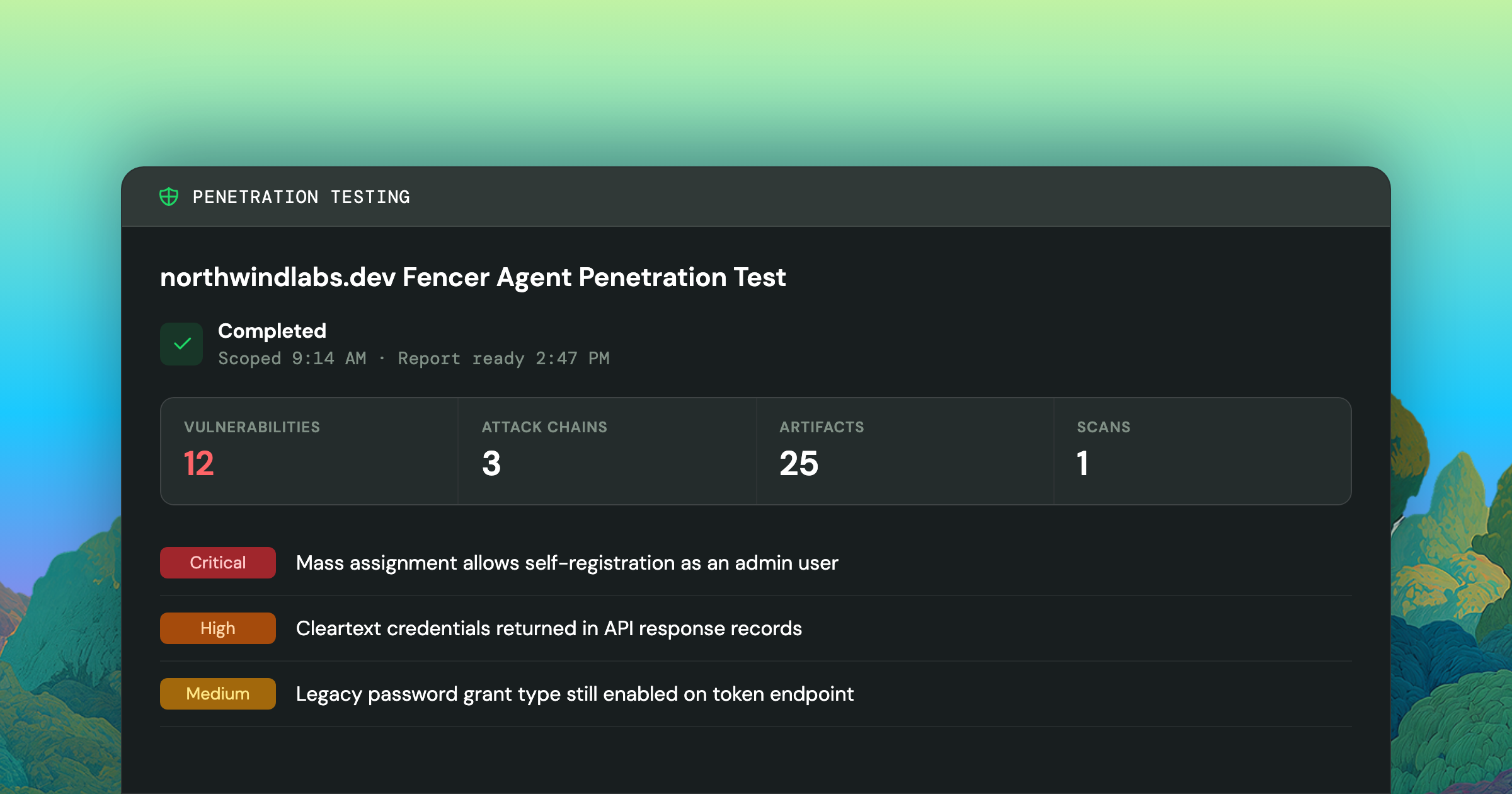
New: Pen testing for your SOC 2, handled today.
Learn More

At 50 employees, the security controls that worked at 10 start to break down. Here's what to add, what to formalize, and how to keep security from becoming a second job.
A 50-person startup needs security controls that go beyond the basics. If you have the foundational controls from the 10-employee stage in place, you're starting from a solid position, but those controls were designed for a stage where one person could track the full security picture from memory. At 50 employees, with a larger engineering team, a growing cloud footprint, enterprise security questionnaires landing in your inbox, and SOC 2 either on the roadmap or already underway, that approach stops scaling.
This guide covers what to add, what to formalize, and what to keep deferring at the 50-employee stage.
At 10 employees, one person could review every PR, know every active IAM role, and spot when something looked off in the cloud console. At 50, you have multiple engineers pushing code simultaneously, a cloud footprint that's grown beyond a single account, contractors and third-party integrations that have multiplied, and a growing list of SaaS tools that nobody has audited since they were adopted. Enterprise prospects are sending security questionnaires that ask about scanning cadence, monitoring coverage, access review processes, and vulnerability remediation timelines, and if you've started or completed your first SOC 2, the audit expects evidence of controls operating continuously.
Here's the full security stack for a 50-person software company selling into mid-market or enterprise accounts.
Controls you should already have in place. These come from the 10-employee stage. If any are missing, start there before adding new layers.
What's new or needs to level up at 50 employees. These are the controls this article covers in depth.
At 50 employees, you have a production application with users, API integrations, and authentication flows that deserve testing against live behavior.
SAST and SCA, which you set up in the 10-employee stage, analyze your code and dependencies before they run. DAST tests your application while it's running, which means it catches a category of vulnerabilities that static analysis cannot see: authentication bypass, injection through live endpoints, misconfigured security headers, CORS issues, and session management flaws. The OWASP Web Security Testing Guide defines 11 categories of web application security tests, and at least six of them (configuration, authentication, session management, authorization, business logic, and client-side) require runtime testing that static analysis cannot perform.
The practical approach at 50 employees is to run DAST against a staging environment that mirrors production closely enough to produce meaningful results without risking disruption to live users. Automated scans that run on a schedule or as part of a release pipeline give you coverage without requiring someone to manually kick off a pen test every time you ship.
DAST sits alongside the SAST and SCA you already have, not as a replacement. Static analysis catches problems in code before it runs, DAST catches problems that only appear at runtime, and together they cover far more of your application surface than either one alone.
At 10 employees, basic alerting on a handful of high-signal rules was enough. At 50, the log volume is higher, the infrastructure is more complex, and the things worth detecting have multiplied. The gap between "we have logging turned on" and "we would know if something went wrong" is where incidents sit unnoticed.
What you need at this stage is not a full enterprise SIEM with a dedicated analyst watching dashboards. Those products assume you have a security operations team, a six-figure budget for the tool alone, and months to write and tune detection rules. You have none of that. What you do need is log aggregation from your cloud and application sources, pre-built detection rules that cover the scenarios most likely to affect a company at your stage, and alerting that routes to the tools your team already uses such as Slack or your issue tracker.
The specific detections that matter at 50 employees are narrower than you might expect. Unauthorized root account usage, unusual IAM activity (new roles created, permissions escalated), large data exports from production databases, login anomalies across your identity provider, and changes to security group rules or network configurations cover the majority of the early warning signals that indicate compromise or misconfiguration.
CISA's best practices for event logging and threat detection, published with international partners in 2024, recommends that organizations at minimum log authentication events, account management activities, process creation, DNS queries, and network connections. The guidance reinforces that logging without detection is just storage, and that the value comes from alerting on events that indicate something has gone wrong rather than accumulating logs that nobody looks at.
Fencer's security monitoring is built for this exact stage: pre-built detection rules, log aggregation across your cloud and application infrastructure, and alerting integrated with the tools your engineering team already uses, without the cost or complexity of a traditional SIEM.
At 10 employees, fixing findings as they appeared was manageable because the volume was low and the sources were few. At 50, findings come from code scanning, cloud posture checks, dependency analysis, container scanning, and external surface scans, often in different tools with different severity scales and no shared ownership.
The 2025 Verizon DBIR found that vulnerability exploitation now accounts for 20% of breaches, a 34% increase year over year, making it nearly as common as credential abuse (22%) as an initial access vector. The pattern is clear: unpatched vulnerabilities that sit in a backlog nobody is triaging become the entry point. At 50 employees, the problem is rarely that you can't find vulnerabilities but that findings are scattered across five tools with no way to compare priority across them, no single owner, and no consistent process for tracking whether something actually got fixed.
A workable vulnerability management process at this size comes down to achieving one unified view across all sources, a consistent priority scheme that accounts for exploitability and reachability rather than just CVSS score, and findings assigned to engineers through the same issue tracker they use for product work. We covered the prioritization framework in detail in how to prioritize security vulnerabilities.
Fencer's vulnerability management consolidates findings from code, cloud, containers, dependencies, and external attack surface into a single prioritized view with guided remediation, so your team isn't context-switching between dashboards to figure out what to fix next.
At 10 employees, you knew who had access to what because you hired all of them and probably set up most of the accounts yourself. At 50, that institutional knowledge has eroded. Engineers have onboarded and offboarded, contractors have come and gone, service accounts have been created for integrations that may or may not still be active, and SaaS tools have been adopted by individual teams without centralized tracking.
If you're pursuing or maintaining SOC 2, quarterly user access reviews are an expected control. But even without a compliance driver, the question is worth asking on a regular schedule: who has production access, who has administrative permissions in each SaaS tool, which service accounts are still active, and whether any of those things have drifted from what you'd actually approve if you were looking at it fresh.
The goal is a repeatable process that runs on a schedule, not a one-time cleanup before audit season. Automating the inventory so you have an accurate list of who has access to what across your infrastructure, code repos, and SaaS tools comes first, followed by quarterly reviews of that list with documented sign-off.
Fencer's identity and access security consolidates your human and non-human identities in one place, flags stale accounts and overpermissioned roles, and generates the evidence your auditor needs to see that reviews are happening on schedule.
At 10 employees, basic device hygiene (disk encryption, screen locks, an MDM for policy enforcement) covers the endpoint side. At 50, the device fleet is larger, engineers are distributed, and SOC 2 auditors expect evidence that company devices meet a security baseline. If you set up an MDM like Kandji at the earlier stage, the infrastructure is already there, and the work now is making sure policies are enforced consistently as the team grows.
The question at 50 employees is whether to add endpoint detection and response (EDR) on top of the MDM. For most 50-person SaaS companies, a lightweight EDR deployed through your MDM gives you meaningful coverage without requiring a dedicated analyst to monitor it, and the telemetry feeds into your broader security monitoring if you need to investigate an incident.
The combination of MDM for policy enforcement and EDR for threat detection covers the endpoint control that SOC 2 expects and that enterprise security questionnaires routinely ask about.
Many startups hit their first compliance requirement between 25 and 50 employees, usually SOC 2 driven by an enterprise prospect who won't move forward without it. Healthtech, fintech, and govtech startups may face HIPAA, PCI, or FedRAMP requirements even earlier.
Compliance is useful at this stage because it forces formalization. The controls in this article, monitoring, access reviews, vulnerability management, and testing, are things your company should be doing regardless of whether an auditor is asking. Compliance frameworks give you a structured reason to implement them and a recurring schedule to maintain them.
The trap is treating compliance as the security program itself. A SOC 2 report is evidence of a control environment, not proof that your security posture is strong. The companies that handle year-two audits smoothly are the ones that built the security work as a continuous process rather than an audit-prep exercise. The companies that scramble are the ones that let the controls lapse between audit windows and spent the month before the observation period backfilling evidence.
The 50-employee stage is where the case for consolidation becomes practical rather than theoretical. When your findings come from five or six different tools with no shared view, no consistent priority, and no unified evidence trail for your auditor, the overhead of managing the tools starts to rival the overhead of managing the security work itself.
Fencer covers what this article describes in one platform: code scanning, DAST, cloud posture, security monitoring, vulnerability management, and access reviews, with findings consolidated in a single view and evidence syncing to your GRC tool. The controls you set up at 10 employees carry forward, and the controls you add at 50 run alongside them without requiring a second set of dashboards or a new vendor for each capability.